Tretinoin vs Prescription Retinol: Your 2025 Pick
When selecting the most effective anti-aging skincare treatment, understanding the critical differences between tretinoin cream and prescription-strength retinol becomes essential for achieving optimal results. While both belong to the retinoid family, their clinical efficacy, tolerability profiles, and application in eye wrinkle cream formulations vary significantly. This comprehensive analysis examines the latest research to help you make an informed decision for your skincare regimen.
The Clinical Evidence: Tretinoin's Superiority
Tretinoin is considered the gold standard for clinically effective topical retinoids used in anti-aging treatments. Tretinoin is the most potent and best studied retinoid for its anti-aging properties. [1] Extensive clinical research demonstrates tretinoin's remarkable efficacy in treating photoaged skin.
Proven Results Timeline
All studies consistently reported that topical tretinoin was efficacious in improving clinical appearance of photoaging in terms of wrinkling, mottled hyperpigmentation, sallowness, and lentigines as early as 1 month and lasted after 24 months. Kang et al. found that improvement could be observed as early as 1 month for coarse wrinkles. Shukuwa et al. also showed that compaction of stratum corneum (the outermost skin layer, which helps with smoothness and texture) and disappearance of atypia and dysplasia occurred after only 1-month application of tretinoin. A histological study carried out by Cuce et al. using high-strength tretinoin found compaction of stratum corneum and increased epidermal thickness after just 15 days of treatment. [2]
Long-term Clinical Efficacy
The long-term safety and efficacy of 0.05% tretinoin in the treatment of moderate to severe facial photodamage were evaluated in a 2-year placebo-controlled clinical trial involving 204 subjects. The study results suggest that long-term use of 0.05% tretinoin emollient cream with a once-daily application is a safe and effective treatment. [1]
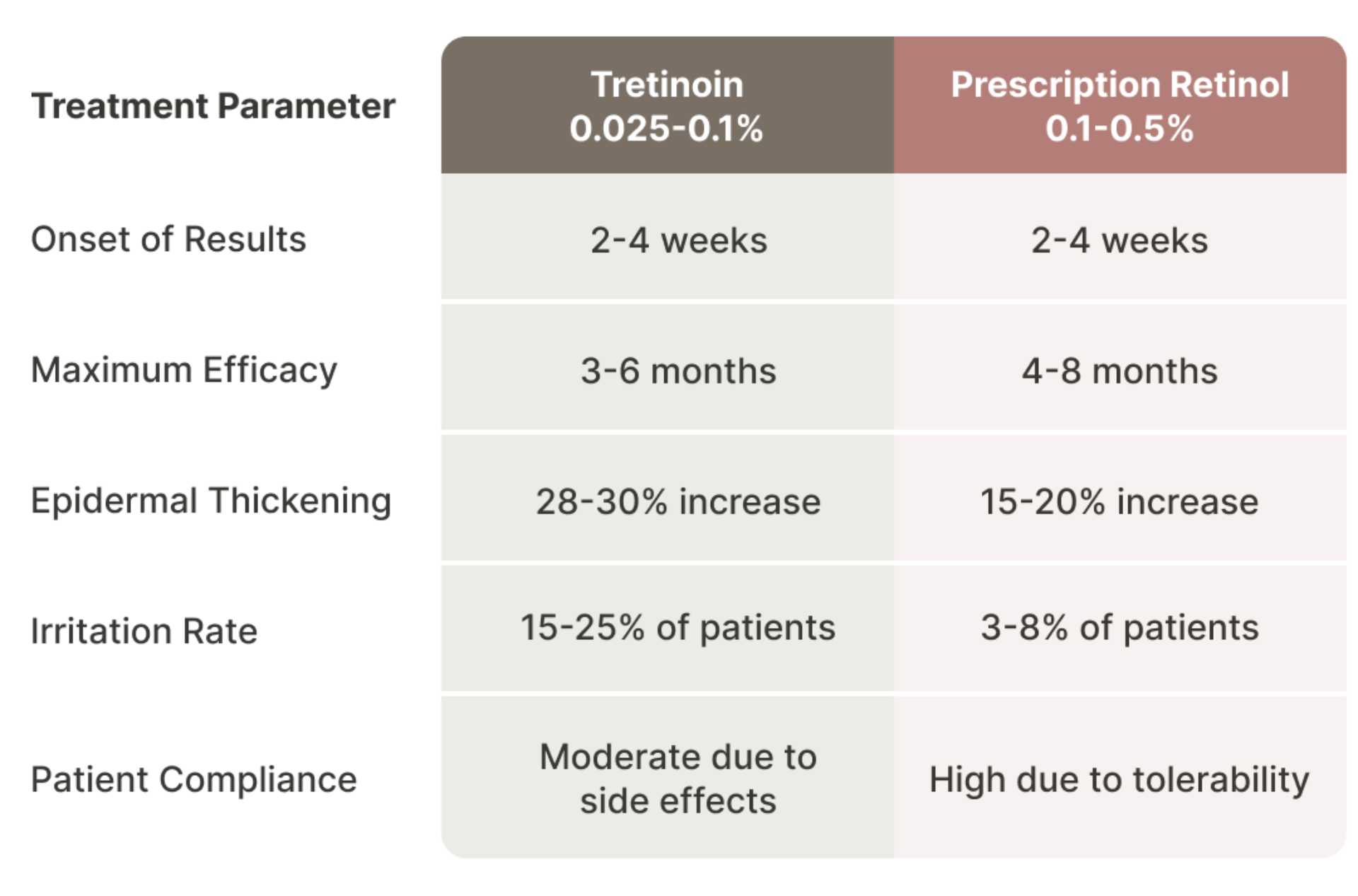
Both 0.1% and 0.025% tretinoin produced statistically significant overall improvement in photoaging of the face compared with use of the vehicle (all ingredients except tretinoin); there were no clinically or statistically significant differences in efficacy between the two concentrations of tretinoin. After 48 weeks, 0.1% and 0.025% tretinoin produced similar statistically significant epidermal thickening (by 30% and 28%, respectively) compared with vehicle (11% decrease) and increased vascularity (by 100% and 89%, respectively) compared with vehicle (9% decrease). [3]
Prescription Retinol: The Balanced Alternative
Prescription-strength retinoid formulations offer significant benefits with improved tolerability profiles. Recent clinical studies reveal compelling efficacy data for these alternatives to OTC retinol.
Clinical Performance Statistics
The recent data analysis involved 6 vehicle-controlled studies focusing on women aged 30 and above with mild to moderate photodamage (n = 352). In this study, topical 0.1% retinol significantly improved crow's feet, facial wrinkles, uneven skin tone, brown spots, and overall photoaging. [4]
Fine lines, radiance, and smoothness were significantly improved as early as week 2 (P<.001). By week 4, hyperpigmentation, overall skin clarity, evenness of skin tone, and wrinkles showed statistically significant improvement compared to baseline. [5]
Superior Tolerability Profile
The tolerability of this retinol was excellent with only 3 subjects experiencing peeling and one experiencing redness after using the retinol. All the reactions were mild to moderate and resolved by week 8. There is a lot to learn from this study. I think the biggest take-away is that this 0.1% retinol, which is a relatively low concentration retinol, provides excellent skin benefits with a very low irritation potential. [4]
Comparative Efficacy Analysis
Head-to-Head Clinical Studies
A recent study showed that the clinical outcome following retinol treatment did not differ from one using retinoic acid to treat photoaging. It is generally assumed that retinol is not as efficacious as retinoic acid, due to the additional step needed to convert retinol to retinoic acid; however, very few studies have been reported directly comparing the two compounds. [6]
Molecular Mechanisms
Retinol, a derivative of vitamin A, has demonstrated its effectiveness in promoting various anti-aging benefits for the skin and is predominantly favored within the category of retinoids. It can stimulate collagen synthesis, inhibit MMP activity, reduce oxidative stress, and modulate gene expression. Retinol has exhibited efficacy in ameliorating the visual manifestations of both intrinsic and extrinsic aging, such as wrinkles, fine lines, and irregular pigmentation. The mechanisms of retinol action may involve the activation of retinoic acid receptors (RARs) and retinoid X receptors (RXRs), which regulate gene transcription and cell differentiation. Retinol may also modulate the activity of growth factors and cytokines involved in ECM turnover and inflammation. [7]
Eye Wrinkle Cream Applications
The delicate periocular area requires specialized consideration when choosing between tretinoin and prescription retinol formulations. This problem is more prominent with tretinoin and tazarotene whereas other retinoids mainly represented by retinaldehyde and retinol are considerably less irritating. [8]
Clinical Evidence for Eye Area Treatment
Skin hyperpigmentation, unevenness, and wrinkles gradually decreased over the course of treatment, both on the left and right parts of the face. Adverse events were predominantly mild or moderate skin irritation. Retinol in liquid crystal formulation is safe and provides significant clinical benefits associated with unification of skin colour, overall skin tone, skin elasticity, and moisture. Regular use of retinol typically results in brightening of the skin and reduced signs of aging. The objective findings confirmed the effectiveness of the procedures.
Musely's Advanced Approach to Anti-Aging Skincare
Services such as Musely make this process more accessible through telehealth, connecting patients with Board-Certified Dermatologists who provide personalized treatment plans. After you sign up and complete your Online Doctor Visit, you'll be assigned one of these dermatologists at checkout. It's LegitScript certified and HIPAA-compliant, and all of its dermatologists are board-certified with publicly available credentials. [9]
Musely stands at the forefront of prescription skincare by offering personalized tretinoin formulations developed by Board-Certified Dermatologists. Musely treatments for dark spots include formulas that contain tretinoin, niacinamide, and other ingredients proven to improve the appearance of hyperpigmentation. Before a person purchases any treatments, a dermatologist reviews each individual's information and provides a treatment plan suitable for their condition. [10]
Customized Treatment Protocols
Our prescribers are Board-Certified Dermatologists who are the most highly trained and specialized in their field. They have helped us develop our formulations and are extremely well-versed in the conditions we treat.
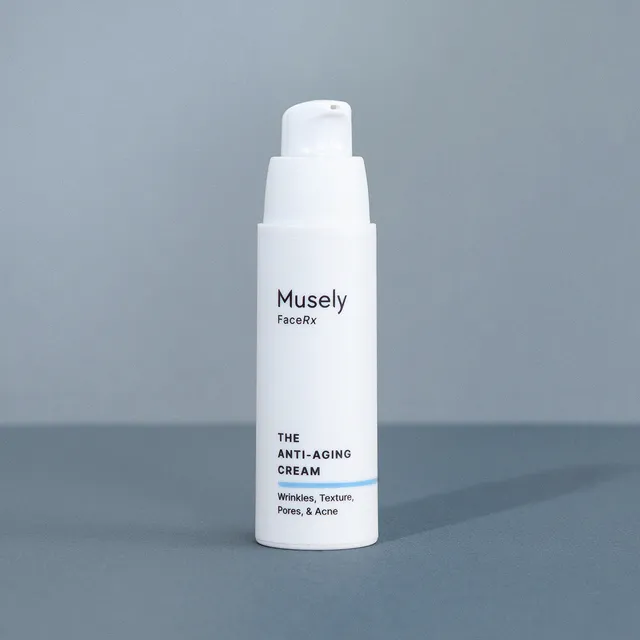
The Anti-Aging Cream is formulated with tretinoin, hyaluronic acid, and niacinamide to treat fine lines, smooth texture, and fade sun damage. Tretinoin is a well-established and clinically tested ingredient for treating fine lines and wrinkles. It works by speeding up the skin cell turnover process, increasing collagen production, and improving skin texture. [11]
Making Your 2025 Decision
Choose Tretinoin When:
You need maximum anti-aging efficacy for severe photoaging
You can commit to professional dermatological supervision
You require the fastest possible results (visible improvements in 2-4 weeks)
You have experience with retinoids and good tolerance
Choose Prescription Retinol When:
You prioritize excellent tolerability with proven efficacy
You're new to prescription-strength retinoids
You need effective eye wrinkle cream applications
You want consistent results with minimal irritation risk
Clinical Considerations
However, it takes three to six months of regular use before improvements in wrinkles are apparent—and the best results take six to 12 months. Because retinoids can cause skin dryness and irritation, doctors often recommend using them only every other day at first and then gradually working up to nightly applications. [13]
The results of published studies suggest that tretinoin, included in formulations regulated as medicines, is the most well-established retinoid with solid evidence of anti-aging efficacy and approved indications for treatment of wrinkles and photoaging. Overall, there is limited evidence from clinical research evaluating the anti-aging efficacy of other retinoids compared to tretinoin as the gold standard. [1]
Conclusion: Your Personalized Anti-Aging Strategy
Ultimately, choosing between tretinoin and prescription retinol depends on your skin goals, tolerance, and comfort level with professional oversight. Tretinoin still remains the most potent and extensively studied option. However, its irritation potential has prompted dermatologists to switch over to less irritating but comparably effective retinoids like adapalene and to some extent retinol and retinaldehyde. [8]
Musely's approach to prescription skincare eliminates the traditional barriers to accessing professional-grade treatments. With Board-Certified Dermatologists providing personalized consultations and custom-compounded formulations, patients receive the optimal balance of efficacy and tolerability for their unique skin needs.
Ready to experience the transformative power of prescription-strength anti-aging skincare? Musely's expert dermatologists will evaluate your skin concerns and determine whether tretinoin will best suit your goals. With freshly compounded treatments, ongoing professional support, and proven results, your journey to healthier, more youthful-looking skin begins with a simple online consultation. Start your personalized treatment plan today and discover why over one million patients trust Musely for their prescription skincare needs!
Products In This Tip
More tips like this

Anti-Aging
Melanie Face-Rx Testimonial

Anti-Aging
Stop The Clock On Your Skin Before It's Too Late

Anti-Aging
Tretinoin Basics: Step‑by‑Step Guide for Clearer Skin

Anti-Aging
Eradicate Years Of Wrinkles In 60 Days, Guaranteed!
Anti-Aging
5 Signs Your Skin Is Aging Faster Than You Are (And What You Can Do About It)

Anti-Aging
An Anti-Aging Skincare Guide For Women After 30

Anti-Aging
Exosome 101

Anti-Aging