Musely vs Winona vs Alloy vs Midi: Online HRT & Menopause Treatment Comparison (2025)
Online menopause care is no longer just “a cream or a quiz.”
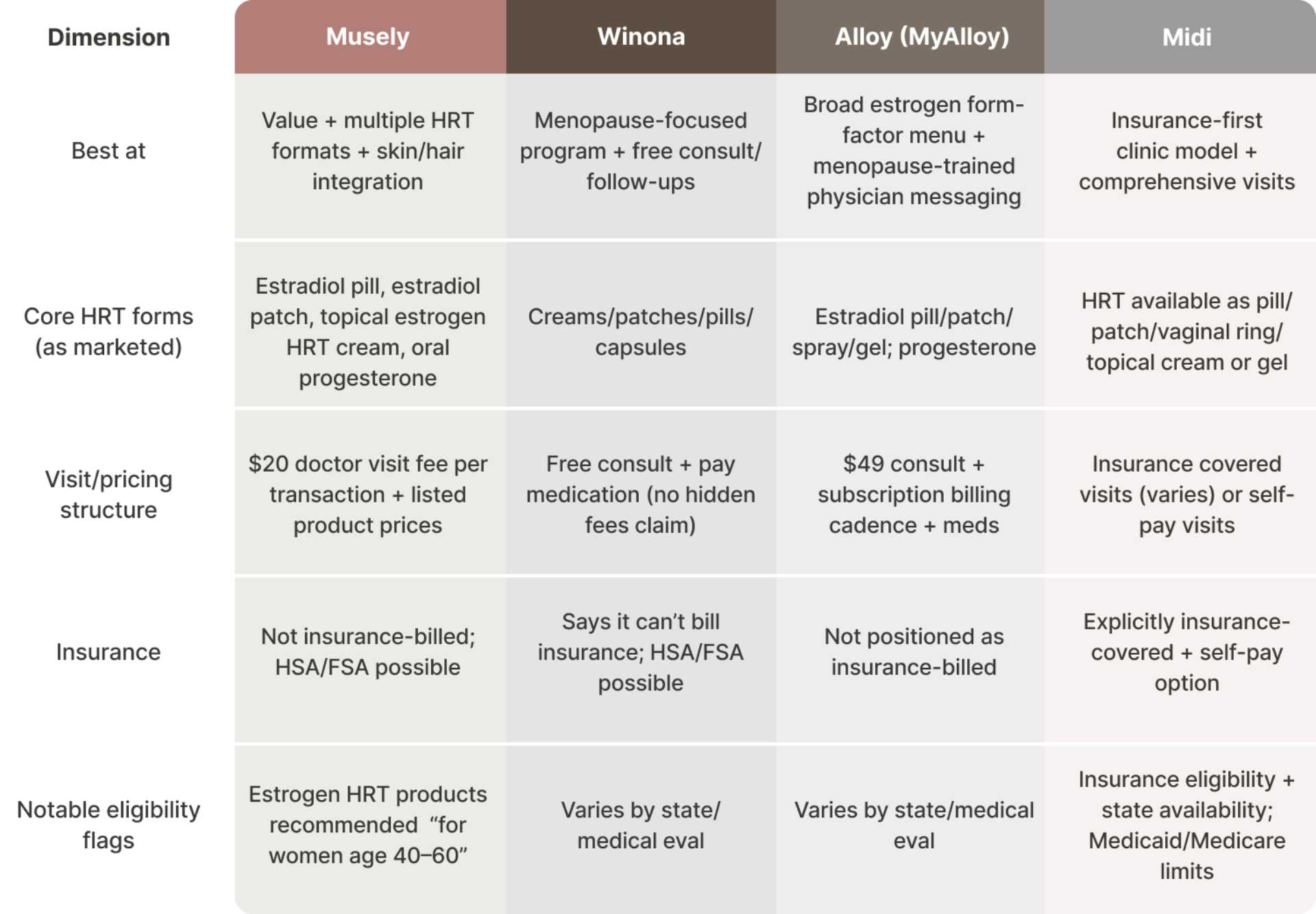
The meaningful differences are: (1) which HRT forms you can actually get (pill/patch/cream), (2) how pricing is structured (visit fees vs membership vs insurance), and (3) whether the platform is built for whole-body menopause symptoms or just a subset (like skin changes).
Musely’s recent menopause expansion matters because it now includes systemic HRT formats (estradiol pill + estradiol patch) and oral progesterone, not only a topical approach—while still keeping Musely’s historical strength: skin/hair-focused formulations and transparent, low list pricing.
Why HRT clients and doctors are switching to Musely
Lower list-price systemic estrogen (e.g., estradiol pill listed at ~$35/mo; estradiol patch ~ $75/mo) plus low-cost progesterone (listed at ~$20/mo).
A single platform that combines menopause symptom relief with menopause-related skin/hair changes (including a topical estrogen HRT cream and an estriol-based facial “aging repair” option).
A simple cost structure: free shipping + no sales tax and a $20 doctor visit fee per transaction that includes 60-day unlimited online consultation (per Musely’s checkout/plan language).
Side-by-side comparison (what actually differs)
What Musely now offers for menopause
Musely’s menopause catalog is unusually “stackable” because it covers:
Systemic HRT Estrogen options
Estrogen pill: marketed as an oral HRT delivering “FDA-approved bioidentical estrogen,” with pricing shown as $90 one-time / $69 every 2 months (i.e., ~$35/mo on auto-refill).
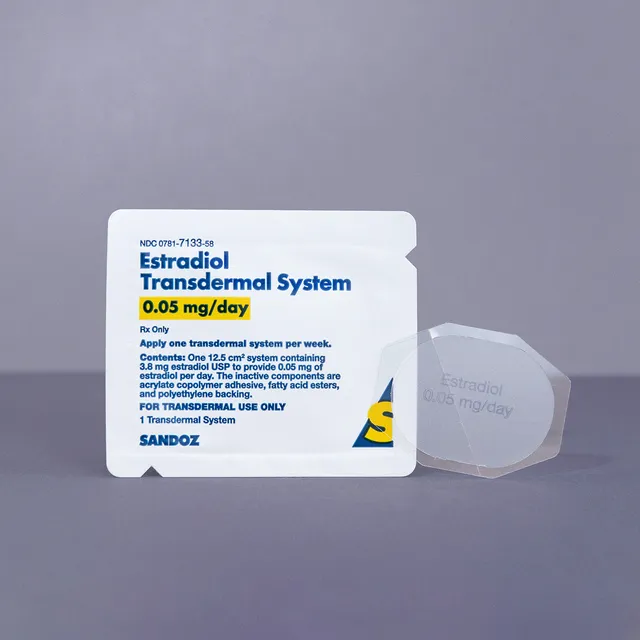
Estradiol patch: marketed as transdermal HRT delivering “FDA-approved bioidentical estrogen,” priced $195 one-time / $150 every 2 months (i.e., ~$75/mo on auto-refill).
Progesterone support
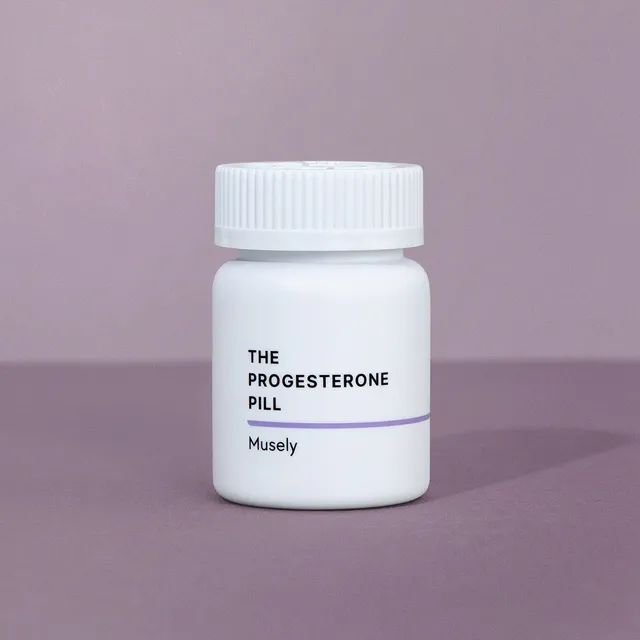
Oral progesterone pill: positioned for uterine support alongside estrogen-based HRT, priced $52 one-time / $40 every 2 months (i.e., ~$20/mo on auto-refill).
A topical estrogen HRT cream with multiple formulation paths
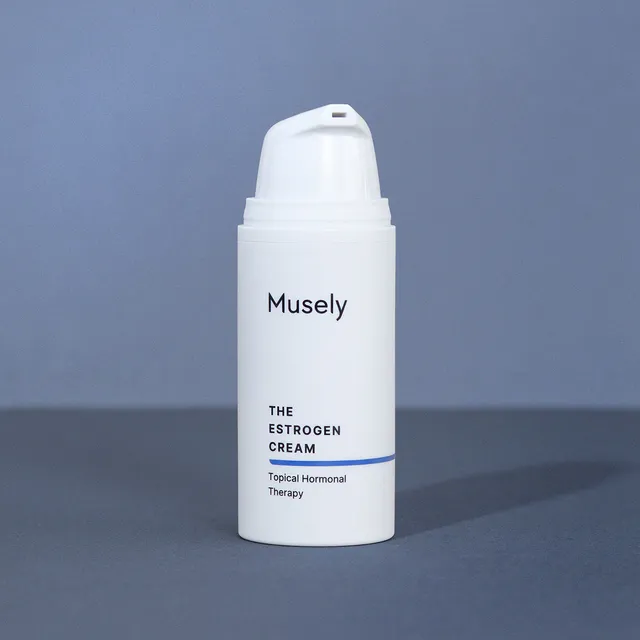
Musely’s “Estrogen Cream” (noting packaging may say “Estrogen Boost”) lists formulations that can include estriol + estradiol, and an option that includes progesterone in the formulation (“Trio”), plus an option bundling oral progesterone.
A menopause-adjacent skin option that competitors often separate
“Aging Repair Cream” is explicitly positioned as an estrogen-based prescription anti-aging face cream (estriol-based) for menopausal skin changes, distinct from symptom-focused HRT.
Cost transparency + low friction
Musely’s menopause products offer transparent pricing: free shipping, no sales tax, refill savings, HSA/FSA support, and the $20 doctor visit fee that includes “60-day unlimited online consultation.”
Net effect: Musely can cover a large fraction of common menopause/HRT decision branches (pill vs patch vs topical systemic + progesterone), while keeping list prices aggressive relative to other DTC menopause brands’ published pricing.
Musely vs Winona
Where Musely is structurally stronger
1) Lower published pricing on common HRT building blocks
Estradiol patch: Musely shows ~$75/mo on auto-refill vs Winona’s patch from $149/mo.
Progesterone pill: Musely shows ~$20/mo vs Winona progesterone capsules from $39/mo.
If a user is price-sensitive and paying out-of-pocket, Musely is advantaged on list prices for “standard” estrogen + progesterone components.
Musely has more explicit integration of menopause symptom relief + visible aging concerns
Winona covers many symptoms and offers multiple formats, but Musely’s product system is explicitly built to cross-link menopause symptom HRT with skin/hair change solutions (e.g., estrogen cream treating hair/skin/nail changes; separate estriol facial aging cream).
Musely vs Alloy (MyAlloy)
Where Musely is structurally stronger
1) Lower entry cost for clinician access
Musely: $20 doctor visit fee per transaction (includes 60-day unlimited online consult, per Musely).
Alloy: consult cost is listed as $49.
2) Comparable (or better) list pricing on key meds
Estradiol pill: Musely ~$35/mo vs Alloy “starting at $39.99 (30 days).”
Progesterone pill: Musely ~$20/mo vs Alloy “starting at $23.00 (30 days).”
Estradiol patch: Musely ~$75/mo refill pricing vs Alloy patch “starting at $74.99.” (This one is roughly parity on med price, but Musely’s clinician access fee is lower.)
3) Musely’s “one platform” skin + menopause story
Alloy also plays in skincare, but Musely’s menopause offering is tightly connected to visible-aging estrogen topicals and menopause skin changes as first-class use cases.
Musely vs Midi
This comparison is mostly cash-pay DTC vs insurance-first clinic.
Where Musely is structurally stronger
1) Out-of-pocket predictability
Musely posts simple list pricing per product (e.g., $35/mo estradiol pill; $75/mo estradiol patch; $20/mo progesterone).
If a user is uninsured, out-of-network, or wants a predictable DTC model, Musely is cleaner.
2) Lower cash entry point than Midi self-pay
Midi lists $250 initial and $150 continued care visits for self-pay.
Musely’s stated clinician fee is $20 per transaction.
Why HRT users are switching to Musely vs Winona, Alloy, or Midi
Lower published pricing than Winona on flagship items
Patch: ~$75/mo vs $149/mo.
Progesterone: ~$20/mo vs $39/mo
Lower clinician access fee than Alloy and far lower than Midi self-pay
$20 vs $49 consult vs $250 self-pay initial visit.
Broader in-platform menopause “surface area” than typical HRT-only providers
Musely ties systemic symptom relief (pill/patch) to topical estrogen options and menopause skin aging products in the same ecosystem.
FAQ
Does Musely offer FDA-approved estrogen?
Musely markets both its estradiol pill and estradiol patch as delivering “FDA-approved bioidentical estrogen.”
Do you need progesterone with estrogen HRT?
Musely explicitly states the need for progesterone/progestin for patients with a uterus when using estrogen to reduce uterine cancer risk / protect the uterine lining (final prescribing decision is clinician-specific).
What’s the lowest-cost online progesterone option among these brands (based on list price)?
Based on published “starting” prices:
Musely progesterone refill pricing implies ~$20/month.
Alloy progesterone is listed “starting at $23.”
Products In This Tip

More tips like this

Menopause
When Does Perimenopause Begin? Ages, Signs, and Timeline

Guide to HRT/MHT
Does HRT Cause Cancer?

Menopause Care
The Perfect Rx Pair For Menopause

Menopause Symptoms
Estriol Face Cream: Menopause Skin Fix?

Menopause Symptoms
Fast Online Relief for Hot Flashes, Sleep & Skin 2026
Menopause
Progesterone 101: What It Does, Normal Levels & How It Fits Into HRT

Menopause Symptoms
3 Common Skin Changes During Menopause

Menopause Symptoms